Choosing the Right Roof Installation for Harsh Weather: What Palm Beach Residents Should Know
South Florida’s weather isn’t just demanding; it’s structurally destructive. Between the blistering ultraviolet radiation of July and the high-velocity microbursts of the Atlantic hurricane season, a Palm Beach roof faces some of the most intense meteorological stressors in North America.
For local property owners, selecting a new roof is not an aesthetic afterthought it is a critical exercise in civil engineering and financial asset protection. To ensure your home survives the next extreme weather cycle intact, you must understand how materials, local building codes, and installation variables interact.
1. Navigating the HVHZ: The Toughest Code in America
Palm Beach County sits squarely within the High-Velocity Hurricane Zone (HVHZ). This geographic designation enforces specialized, mandatory structural regulations within the Florida Building Code.
- The Mandate: Your roof system must be engineered to withstand sustained winds and gusts exceeding 150 to 170 MPH, depending on your exact coastal proximity.
- The Hidden Risk: Many out-of-state or cut-rate contractors use generic fastening patterns. In the HVHZ, specialized ring-shank nails, tighter spacing intervals, and verified uplift tracking are required by law to prevent your roof deck from detaching under severe negative pressure.
2. Comparing Material Resilience for the Palm Beach Climate
No two roofing materials behave identically under extreme weather. Your choice dictates your home’s thermal efficiency and its structural survival threshold.
A. Concrete & Clay Tile
- Weather Profile: Highly resistant to rot and insect damage; heavy enough to resist severe wind uplift when anchored with modern mechanical screws or heavy-duty foam adhesives.
- The Catch: Thermal expansion can cause cracking over decades of intense heat. It requires a heavy-duty, multi-ply Secondary Water Barrier (SWB) underneath to handle sub-tile moisture.
B. Standing Seam Metal
- Weather Profile: The gold standard for hurricane resistance. Interlocking panels conceal fasteners, meaning there are no exposed penetrations for high-velocity water to exploit. It reflects solar radiation efficiently, lowering cooling loads.
- The Catch: Higher initial capital investment, though offset by its 50+ year lifespan.
C. Architectural Shingles
- Weather Profile: Modern, heavy-duty laminate shingles carry wind ratings up to 130–150 MPH when coupled with specialized starter strips and six-nail per-shingle patterns.
- The Catch: Rapid UV degradation can cause granule loss over time, reducing life expectancy faster in South Florida than in northern climates.
3. The 4 Essential Pillars of a Hurricane-Proof Installation
A roof fails when its components do not work as a unified system. True storm protection relies on the hidden details:
[Solid Plywood Deck] ➔ [Ring-Shank Nailing Pattern] ➔ [Self-Adhering Underlayment (SWB)] ➔ [Wind-Rated Outer Layer]
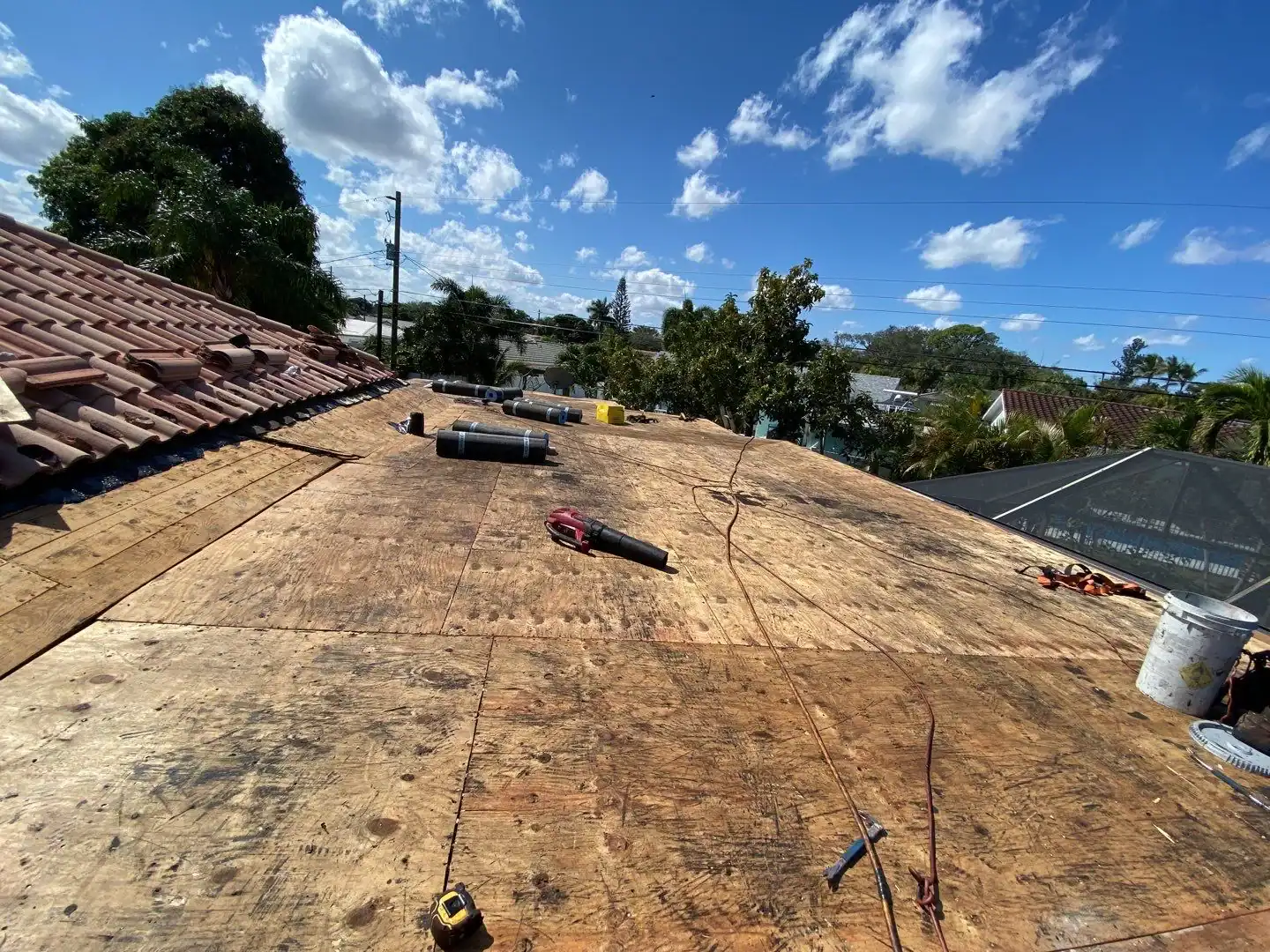
- Enhanced Deck Fastening: Standard staples or smooth nails pull out easily. Code dictates closely spaced, ring-shank nails driven directly into the trusses to resist extreme wind uplift.
- Secondary Water Barrier (SWB): If your shingles or tiles blow off, a self-adhering, peel-and-stick underlayment acts as a waterproof glove, preventing catastrophic interior flooding.
- Robust Drip Edges & Flashing: Water is pushed sideways at 100+ MPH during a tropical storm. Heavy-gauge metal drip edges must be fastened precisely to keep wind-driven rain out of your fascia and soffits.
- Algae-Resistant Engineering: The intense humidity of Palm Beach fuels cyanobacteria (streaking). Opt for materials infused with copper or zinc granules to inhibit growth naturally.
4. Financial Advantages of Weather-Resilient Installation
Investing in a verified, code-compliant HVHZ roof installation yields substantial immediate financial dividends beyond simple peace of mind:
| Benefit | Impact on Property Owner |
| Wind Mitigation Credits | Drastically reduces annual Florida homeowners insurance premiums. |
| Fewer Insurance Denials | Fully permitted, documented builds prevent insurers from exploiting installation technicalities during claims. |
| Asset Longevity | Eliminates the costly cycle of repetitive structural repairs after minor tropical storms. |
Partner with Palm Beach’s Proven Roofing Authority
At Aastro Roofing, we don’t just build roofs; we engineer structural shields. As a state-licensed contractor (Lic #CCC1330967) specialized in High-Velocity Hurricane Zone criteria, we’ve protected Palm Beach properties for over three decades with custom, factory-certified installations.
Don’t wait for hurricane season to test your property’s vulnerability.
[Schedule Your Free 21-Point Structural Roof Inspection Today] or call our local team directly at (561) 409-3280 to speak with a coastal roofing expert.


0 Comments