How Recent Florida Building-Code Changes Affect Your Roof Replacement
Quick Answer: Florida’s 8th Edition Building Code (effective since December 31, 2023) requires most re-roofs to use sealed roof decks, ASCE 7-22 wind ratings, and stricter fastening. The good news: Florida Statute 553.844 now limits the old “25% rule.” If your roof was built or repaired to 2007 code standards or newer, only the section being replaced must meet current code not the whole roof. A 9th Edition is coming December 31, 2026, and will loosen these rules further, allowing partial roof recovery in more cases. Below, we break down exactly what changed, what it costs, and what to ask your contractor.
Why This Matters Right Now
Florida rewrites its building code every three years. Each cycle gets tougher on wind resistance. That’s not bureaucracy for its own sake. It’s a direct response to hurricane damage data. If you’re planning a roof replacement in 2026, you’re working under rules that are noticeably stricter than what covered your home a decade ago.
What Actually Changed in the Current Code
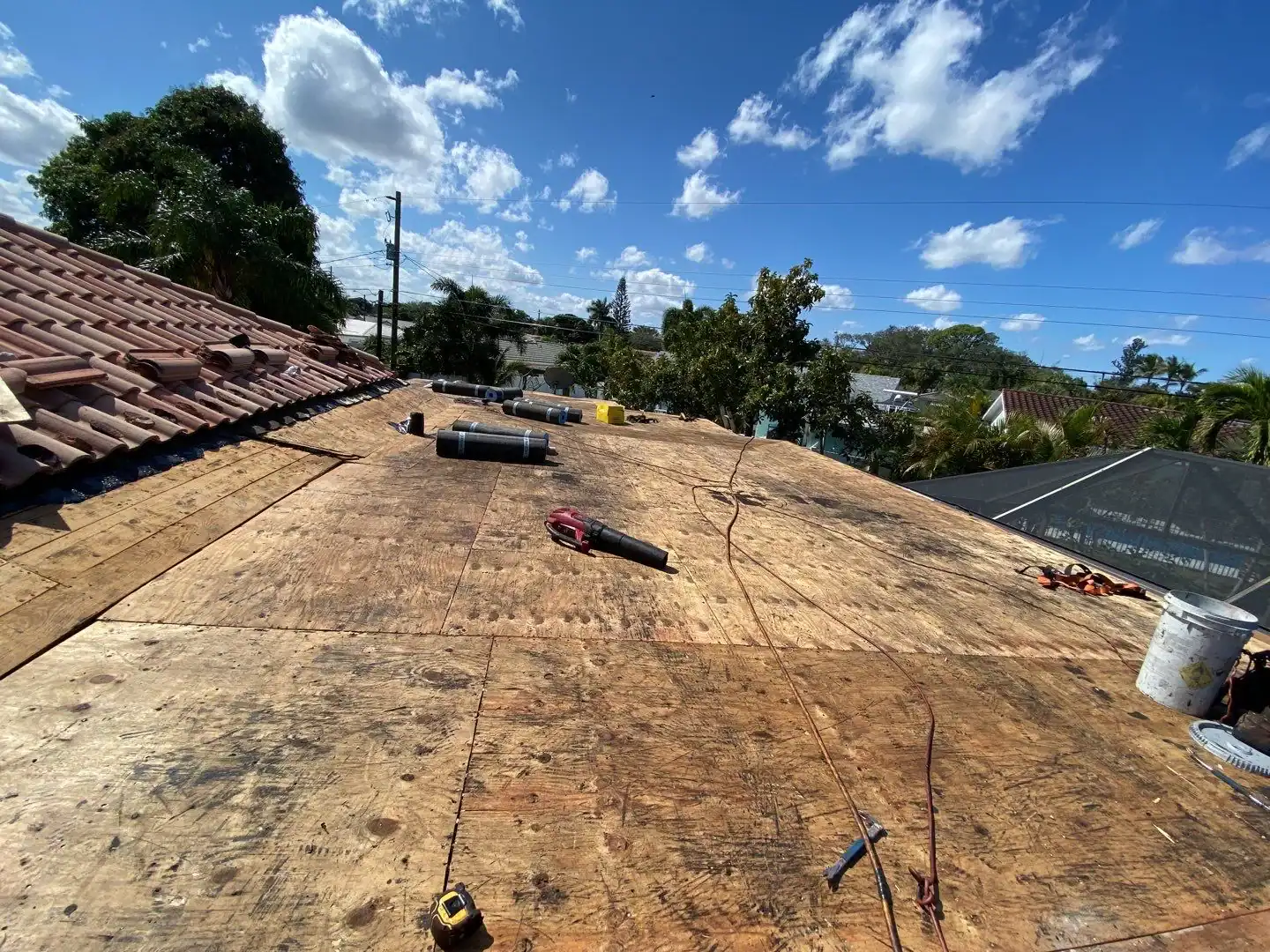
Sealed roof decks are now standard. Homes in wind-borne debris regions need a secondary water barrier — either self-adhering membrane or sealed seams under the primary roofing. This single change cut water-intrusion insurance claims sharply after recent storms.
Wind maps got redrawn. The 8th Edition adopted ASCE 7-22 as its structural loading standard, replacing the older ASCE 7-16 maps. Some contour lines shifted inland. Depending on your county, your home’s design wind speed may be higher than it was under your original permit.
Fastening got tighter. Roof decking now typically needs ring-shank nails at closer spacing in high-wind zones. Roof-to-wall connections must resist higher uplift forces than older toe-nail methods allowed.
Materials need documented approval. Every product shingles, tile, metal panels must carry a valid Florida Product Approval or Miami-Dade NOA number for your wind zone.
Does a Partial Repair Trigger a Full Replacement?
This is the question we hear most, and it’s called the “25% rule.” Historically, if storm damage or repairs touched more than 25% of a roof section within 12 months, the whole section had to be brought up to current code — often turning a repair into a full tear-off.
Senate Bill 4-D changed that. Under Florida Statute 553.844, if your existing roof was built, repaired, or replaced to 2007 Florida Building Code standards or later, only the portion actually being worked on needs to meet current code, even past the 25% threshold. Older systems, built before 2007 code, may still face broader upgrade requirements. Your local Authority Having Jurisdiction makes the final call, so get this in writing before signing a contract.
What’s Coming in the 9th Edition (December 31, 2026)
Florida’s Building Commission has already reviewed over 1,500 proposed code changes for the next cycle. Roofing-specific proposals include allowing partial roof recovery instead of mandatory full replacement, preserving existing attic insulation during re-roofs, and possibly easing the 25% rule further. If you’re planning a project for late 2026 or 2027, ask your contractor how the transition timing affects your permit.
Case Study: A Real Tampa Bay Reroof
A 2004-built home in Pinellas County took wind damage covering 30% of its roof after a 2025 storm. Under the old rule, that would have forced a full tear-off. Because the original roof had been recovered in 2011 — after the 2007 code cutoff the homeowner qualified under Statute 553.844. Only the damaged section required upgrading to current sealed-deck and fastening standards. The project cost came in near $9,400 instead of an estimated $19,000 for a full replacement, and passed inspection on the first visit.
Frequently Asked Questions
Does my new roof have to meet current code, even if my house is older? Yes. Florida requires re-roofs to meet the code in effect at the time of the permit, not the code from your home’s original construction year.
What is the Florida 25% roof replacement rule? It’s the threshold that once forced a full roof-section replacement whenever repairs exceeded 25% of that section within a year. Statute 553.844 now limits this for roofs already compliant with 2007-or-later code.
Will the 2026 code changes make roofing more expensive? Some line items will cost more — thicker underlayment, ring-shank fasteners, documented product approvals. Many homeowners recoup part of that cost through lower insurance premiums for wind-mitigated roofs.
Do I need a permit for a roof replacement in Florida? Almost always, yes. Unpermitted roofing work can void insurance coverage and complicate a future home sale.
How do I know if my contractor is licensed for this work? Ask for their Florida state roofing license number and verify it through the Department of Business and Professional Regulation’s license search tool before signing anything.
About the Author: This article was reviewed by Jason Blair a Florida state-licensed roofing contractor with over 15 years of experience in wind-mitigation and storm-repair projects across Central and West Florida. Code details reflect the Florida Building Code, 8th Edition (effective December 31, 2023) and publicly available drafts of the 9th Edition (effective December 31, 2026). This content is educational and not a substitute for guidance from your local building department, which has final authority over code interpretation.